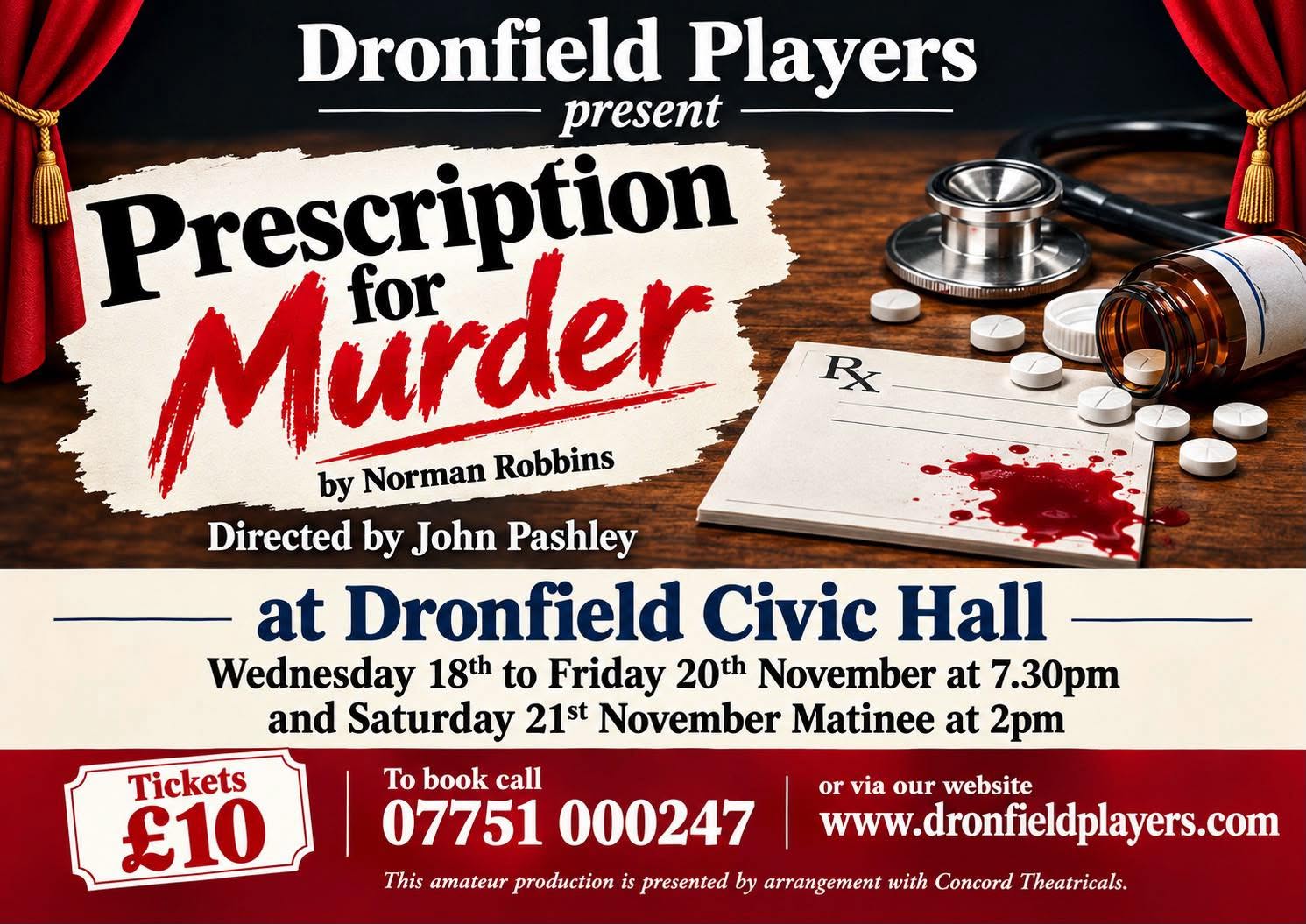
Dronfield Players’ Prescription For Murder – 18 November 2026, Dronfield Civic Hall
Review by Claire Stanley.
Anyone who knows me understands I love a whodunit and this was a classic from the Dronfield Players last night. It is always a pleasure to see their shows and ‘Prescription for Murder’ is a great choice for their Autumn season. Written by (Norman Robbins) the play is set in the seemingly tranquil village of Bere Knighton, Devon. This engaging thriller combines psychological intrigue, unexpected revelations, ingenious red herrings and a generous measure of village humour.
The action unfolds in the living room of local GP Dr Richard Forth (Daniel Roberts) and his wife Barbara (Margaret Harrison) whose whirlwind romance has led to an apparently happy marriage. However, Barbara is plagued by a succession of mysterious and unexplained illnesses, which Richard increasingly dismisses as psychological in origin. The atmosphere takes a sinister turn with the arrival of Eric Dawson (Richard Thompson), a stranger who claims to have known Richard’s late second fiancée. Dr Forth vehemently denies that such a woman ever existed, immediately casting doubt over his past and the credibility of his protestations. When Barbara makes a disturbing discovery concealed within a book, her health deteriorates further and an unsettling sense of menace begins to permeate the household. With deception and an ever-growing web of suspicion, the question remains: who can be trusted, and who has murder on their mind?
The set (circa 2000’s) was very well put together. A tasteful middle class sitting room complete with French doors, a stained glass window, desk and study lamp plus a sofa and chair was definitely fit for a GP like Dr Forth. I particularly liked the well placed and angled photo on the mantle piece of ‘Dr Forth and Barbara’. Canny touch! Credit to all the set building, design and decor crew here. The placing of the furniture also meant that when couples stood together there was room for them to gesticulate without being overcrowded and for good variances within scenes where actors stood talking and then seated where appropriate, especially for the more serious parts of the plot. We are signalled that Scene One is starting by ten seconds of classical music, a pleasing introduction. Such interludes are great sound cues to begin every scene thereafter (credit Sally Biancardiand John Pashley). As alluded to earlier, the focus on books is necessary to the plot. We initially find ‘Dorothy Livingstone’ played very competently by (Rachel Cooper Bassett), discussing the many books of Dr Forth and giving them a good dust. This lady is the dependable home help/cleaner and I was immediately impressed by Dorothy’s Devon accent which is apt for her role in the pecking order of the household and as such gave her character a good dose of warmth. Additionally, the many book props did not phase her during her long dialogue and these were handled well adding authenticity to the scene. Dorothy’s appearances are integral to all scenes of the plot and her slightly gossipy nature is exploited to “explain” to the audience some parts that we are not privy to on stage. This device worked well because she was played so believably.
Barbara Forth was played as a genteel and pleasant caricature of a GP’s wife, almost pantomime at times and this proved effective, especially in the second act; we were drawn in by her mysterious ailments as she begins to question her husband’s motives. The body language of the character was skilfully played to depict illness and this added to the portrayal. Such suspense and whiffs of murder are soon to be broken up with humour, -cue the engaging characters of Mary and Allan Haigh (Erica Leach), (David Cheetham). This couple are friends of the Doctor and his wife, they appear to know them quite well,-becoming concerned at Barbara’s growing illnesses. Mary’s comic deliveries are played to perfection here as her diction and projection are noticeable alongside strong stage presence. Along with Allan who gets to perform the more deadpan “receiver of henpecking” role, their duo is a welcome relief and the actors here create great chemistry as a couple. I always look at audiences when witty lines are aimed to provoke reaction. This section of script has many “crown green bowling bore” quips which are really amusing and the actors here didn’t just play for laughs they genuinely evoked them because their facial expressions and behaviours matched the lines. Very well done!
When Eric Dawson the salesman appears he is a stranger to the main characters and has a lot to say about who he thinks is involved in the Dr Forth’s past. Although a little nervous in Act One with dialogue, the physical acting portraying the character’s injuries is engaging and we the audience are intrigued by what is unfolding. It is noticeable through the well steered direction of the play (John Pashley) that the differences of character are given appropriate placing on stage. Eric a “stranger” stands awkwardly upon entrance where as the Doctor’s ex girlfriend ‘Julia Moore’ (Rachael Hope) makes herself immediately at home and sits down. She is played excellently as the sophisticated smartly dressed wealthy “rival”. Her character is meant to be self assured and this really comes across. Applying make up with ease as she delivers her lines smoothly, or taking in a drink or two, this character held my attention throughout. She clearly retains romantic feelings for Dr Forth and her continued closeness to the couple created an uncomfortable undercurrent of tension and suspicion. Dr Richard Forth’s character oozes authority and this performance was credible as a man who is impatient with his wife’s illnesses and yet also convincing as a “busy” village GP. The acting was slick, he moved quickly with his Doctor’s Bag prop giving off the air of someone who is as busy and important as we need to believe him to be.
With a play like ‘Prescription for Murder’, the success of the production depends heavily on the actors’ ability to balance suspense, character development, comic timing and audience engagement and I think Dronfield Players achieved this tonight. The pacing held momentum and at pivatol plot points you could hear a pin drop. We were all attentive to see what happened next! As a nod to the well thought out PR of ‘Prescription for Murder’, (John Pashley, Sarah Betts, Alison Pashley),I particularly admired the introduction of audience participation. We were all invited upon entrance to the hall before taking our seats, to have a slip of paper which we could complete at the interval, to guess who we thought was the murderer…Could you guess accurately??? This play continues tonight until Saturday (19th-21st November). I would recommend it, you are in for a really pleasant evening. All in all, a great accomplishment Dronfield Players, Congratulations!