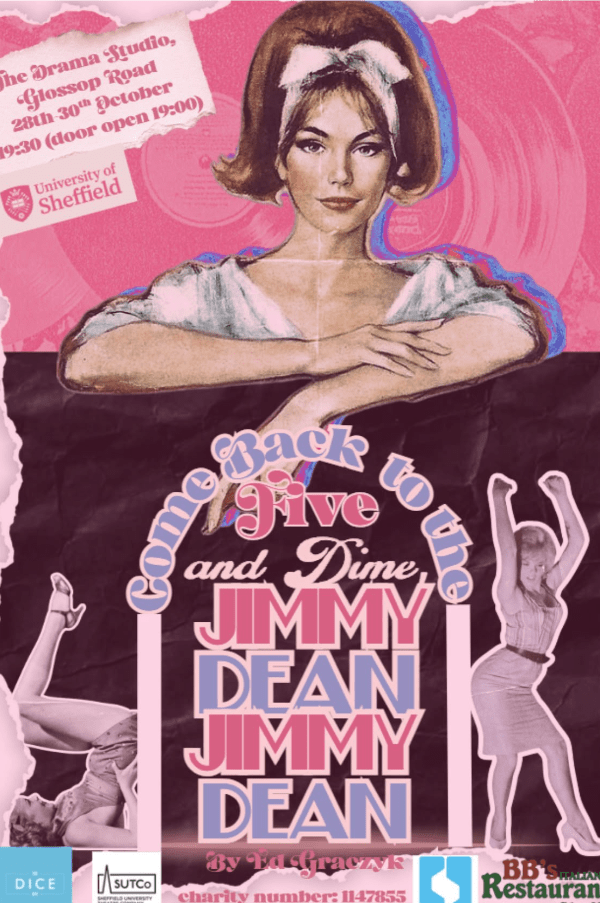
SUTCo’s Come Back to the 5 and Dime, Jimmy Dean, Jimmy Dean – 28 October 2026, Sheffield University Drama Studio
Review by Kiera Rhodes.
I attended the opening night of SUTCo’s Come Back to the 5 & Dime, Jimmy Dean, Jimmy Dean co-directed by Carly McCollin and Luke Hookham, and originally written by Ed Graczyk in 1976.
The story follows the friendship of Mona and Sissy alongside that of the rest of ‘The Disciples of James Dean’: Joe and Joanne, Stella May, Edna Louise, and by extension Juanita, the owner of the diner where the whole play is set.
We are eased into the play by Imogen Eyre as Juanita yelling the title line from offstage to an unseen Jimmy Dean. Her character throughout was like a rock for the audience. She was (almost) always there and was the voice of reason at points, as well as being a familiar character in the flip flop of flashbacks to 1955. Eyre played Juanita as a loving mother figure to the group which fit the role perfectly.
Kicking off our flashbacks was 1955 Sissy, played by Wrenna Clarke. She brought this wonderful childlike air to the character while also being streetwise and hardened to life already by age 20. This paired so well with Bethany Collins’ 1955 Mona who was much more straitlaced and reserved. Collins’ also had the challenging task of seeming innocent at first while knowing that her character was keeping a huge secret from her friends.
Lilia Harnett’s 1975 Mona also had this challenge, but as she plays the older Mona who should have grown less innocent by this time, it is odd that her character growth is barely non-existent, we learn why by the end. Once Harnett’s character arrives, we follow and grow close to her as an audience, and by extension Collins’ character too. The connection garnered between us and Mona throughout time makes it incredibly jarring when her secret comes out, as if we are also one of the disciples hearing our friend tell the secret they’ve kept from us, turning their character sour in our eyes.
Similarly to 1975 Mona, the growth of Holly Pearce’s 1975 Sissy – who reminded me of the character Max Black from 2 Broke Girls – at first seemed to have not changed much. She was still street wise and hardened to life as a busty woman, but as the play continued, we learned she doesn’t have this hateful streak that Mona does. She is more open to life beyond her understanding, despite never having left her hometown. Pearce took Clarke’s childlike characterisation and made Sissy still very playful in 1975 form.
Joe, played by Dylan Smith, was great as the shy male best friend trope with a silent crush. His counterpart, Molly Mason as Joanne, played the rich, confident woman excellently. The juxtaposition between the two characters really showed the growth over the 20 years that had occurred for her.
Stella May (Max Preston) and Edna Louise (Tilly Harradine) were an excellent comedic relief duo. Their friendship while toxic at times, was similar to that of siblings with a loving bickering behind it all. Harradine has the awkward and confused-but-got-the-spirit friend down to a tee, while Preston has great physicality and comedic timing; he played the not-bothered-but-secretly-wants-to-know-everything friend hilariously.
I loved the use of pink lighting to reflect flashback as pink isn’t usually the go to colour for this. The sound design also really helped to set the scene for the-middle-of-nowhere Texas, although a bit loud at points as I had to strain to hear the performers over the jukebox / radio. The set, while mainly painted cardboard, fit the decrepit Texan diner chic and barely remembered memories vibe, and the door closing mechanism was beautiful to see. I also enjoyed the little gags in the set such as a ukulele hanging on the wall instead of a guitar as that’s all there was space for, the little cardboard car appearing out the window as Joanne pulled up, water being 1$ while Orange Crush was 5¢ – what is Orange Crush made of to be so much cheaper than water – and then the prices increasing when Joanne walked in!
While being quite a straight play with some serious topics touched upon, especially for 1976, the comedic touches really helped with the slow pace usually attached to older plays.