Hasland Theatre Company’s Happy Families – 14 September 2026, Hasland Playhouse
Review by Nicola Bourne.
Hasland Theatre Company kicked off their new season last night, at The Playhouse, with their production of John Godber’s 1991 play, Happy Families. Its autobiographical storyline, which conveys relatable tales of the playwright’s family tensions, while he was growing up in the north of England in the 70’s, brings a stark realisation that our own family’s quirks and squabbles are not as unique as we may suspect and shows us that many themes and situations are indeed, universal experiences. Sarcastically titled, it’s a nod to the card game of the same name, acknowledging the hotchpotch of characters thrown together in a family setting, expecting naively to get along with each other.
Many of Godber’s plays are known for their northern, working-class humour, and, his most personal work, Happy Families is no different. You’ll instantly recognise (and adore) the hard-edged Yorkshire wit and will have a few good laughs along the way, but, if you go in expecting a fast-paced plot, you’ll be disappointed. This play’s strengths are, undoubtedly, in its simplicity and ability to evoke emotion and recognition from its audience, and, with a good cast, this is done competently, with effective storytelling in its most basic, stripped back form. Maybe, you get more from it, I originally thought, if like myself, you have lived through the 70s and are able to appreciate the parental struggles and ambitions for your children. I consider myself corrected, on that point, however, when my own daughter fully understood these emotional nuances and thoroughly enjoyed the play, despite her younger age.
I probably won’t be alone, in recognising myself, somewhat, in Anne Hawkswood’s strong matriarchal character, Dot. In one of her best performances, in my opinion, she encapsulates a loving mum and wife, albeit a harsh and critical one at times, routinely threatening violence and expressing disappointment, but done through the lens of a mother wanting the world for her child (and praising their achievements to all who listen). It’s everyone else, who is “crackers” and her daily stresses are relieved by trying to feed everyone up and putting the world to rights with a good cup of tea! Only as her son’s ambitions are realised, do her own aspirations increase, and her upgrade to “Early Grey” tea does get a few chuckles!
Her poor husband, Vic, played so tenderly by Dave Banks, appears at peace with his wife’s perpetual beratement. In a household, that struggles to show the affection, that is so clearly there, I suspect he knows it comes from a good place. His strong Yorkshire accent adds layers to his character’s acceptance of his simple life and his hope that John doesn’t follow him down t’pit! His hurt explanation, of his unwanted clapping at John’s graduation ceremony, is a heartwarming reminder that he lives vicariously through his son, and I do hope he enjoyed his celebratory half a lager!
To anyone who lived through the 70s, there are some nostalgic reminders of the era: Blue Nun wine, arctic rolls, Kays catalogue and Reader’s Digest, to name a few, that no doubt made you feel very sophisticated at the time! John’s personal ambitions, though, mean he outgrows his family’s small world and Nathan McNicholas does a great job in this main character role, narrating his memories of that period. Both lighting and “freeze frames” provide a dreamlike clarity for the audience, showing where one memory ends and another starts and enable John to explain his feelings, while stopping the action around him, leaving the other characters in limbo. Nathan’s character evolves well from childhood shyness (I’m picturing a funny doctors and nurses play scene here) through to teenage rebelliousness, and he somehow manages to make me feel both empathy and anger towards him, mainly because he plays his hurtful, ungrateful teenager especially well.
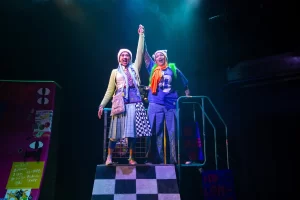
The set itself is equally simple; apart from the garden, displayed onscreen, the 70s interior cleverly provides the setting for the entire play, where memories of lace armchair covers and retro décor are reignited. Other characters come and go, including John’s grandparents Liz and Jack, played by Maggie Phelan and Rob Dean, Dot’s sisters, Doris and Edna (Rachel Smith and Kathryn Hardy) and Edna’s daughter Rebecca, played by Annie Phillips.
Maggie captures Liz’s character beautifully, especially when deceased and dressed completely in white. She is completely devoted to Jack, who in turn, is the epitome of my own father, stubborn and fierce! Rob’s character is so relatable that there were a few knowing looks exchanged between myself and my own daughter, especially when he tells it how it is. His grief, from the loss of his wife, is tangible and, as his own past is revealed, he can be forgiven for his aggressive outlook on life.
Rachel’s Doris is likeable and easily pleased, in contrast to aspirational Edna, whose snobbishness and one upmanship rubs off onto her daughter, Rebecca and causes feelings of inferiority amongst the rest of the family. Freeze framing Edna, while the others moan about her, is an effective decision, and if these parts had not been so well played by everyone, then Godber’s family relatability wouldn’t have landed.
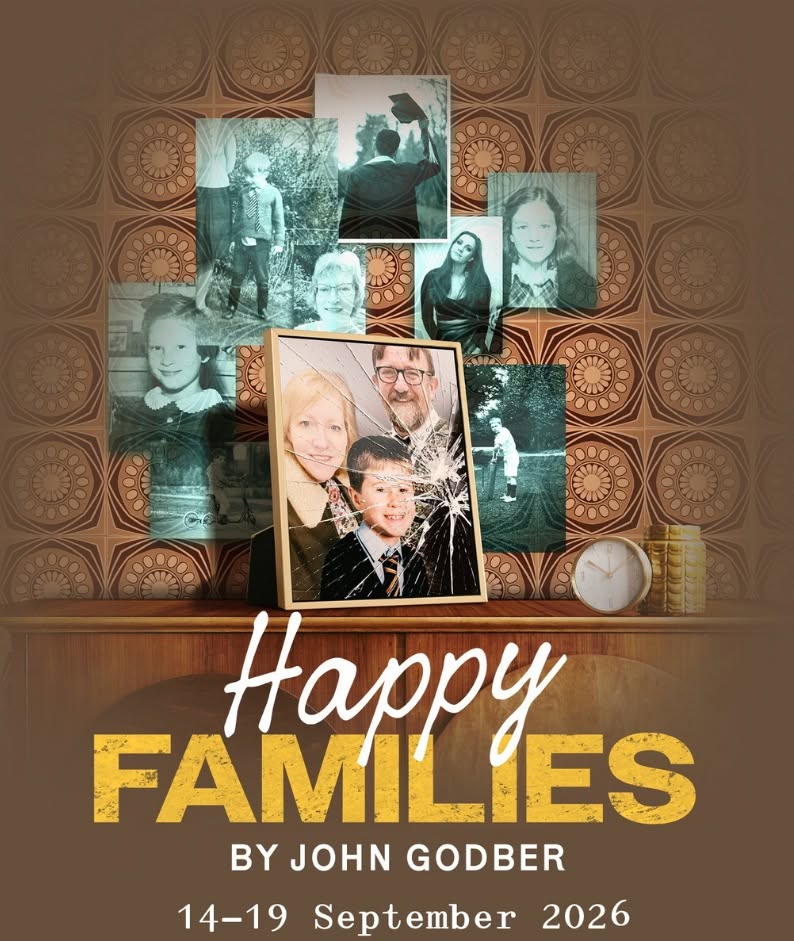
Ray Dell, assisted by Andrew Heyna, has directed a piece, that absolutely hits this mark and holds up a mirror to our own complicated family dynamics. On opening, his introduction on screen, of the cast’s photographs, from children to adulthood, is an especially poignant moment and one that seems in keeping with Godber’s own memories.
Enhanced by evocative background music, 70s costumes and a strong element of pathos, this is a modest, but emotive production and one that we can all identify with. After all, who hasn’t been embarrassed by our parents, or experienced the generational divide, sibling rivalry or parental expectations? Happy Families is a sharp, nostalgic reminder that genuine love is often hidden behind petty quarrels and misjudged criticism and that our family, like it or not, shape us along the way. Maybe we should all accept we live in a “madhouse” where tinned ham is as exciting as it gets!!!