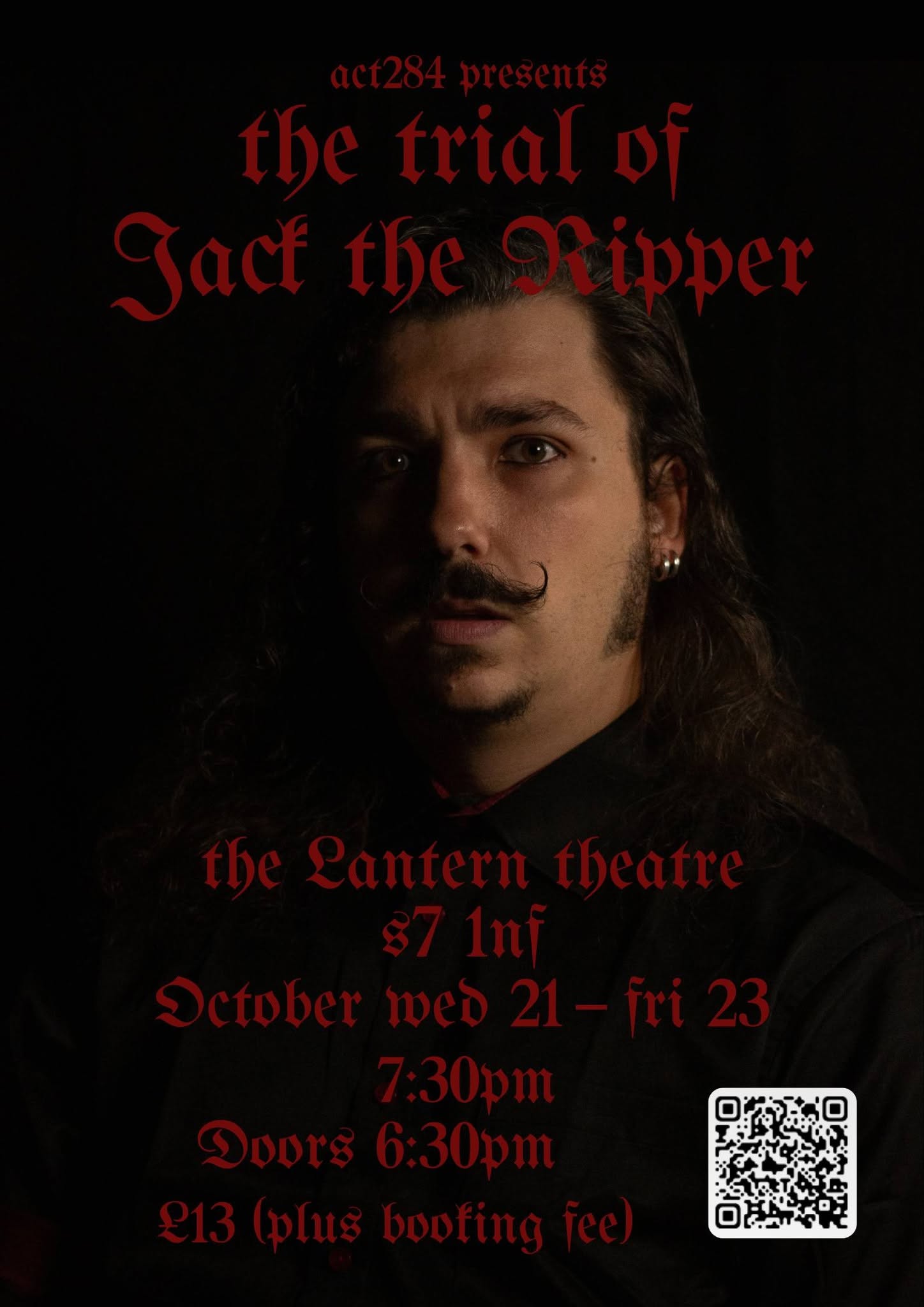
Act284’s The Trial Of Jack The Ripper – 21 October 2026, Lantern Theatre
Review by Peter Taranaski.
There are few serial killers in history that are as active in the mind and as powerful as the myth that is Jack the Ripper. When we wonder at his identity and watch a film or play, all the familiar parts of the story bring it to life. The streets of London are there in their glory, men with moustaches, the Victorian gaslights and the rolling smog that isolates people in the night; it all makes the narrow alleyways of the capital a lot more scary and make venturing out from the safe haven of the East End pub a riskier venture.
We had the pleasure of seeing Act286’s take on this notorious killer in “The Trial of Jack the Ripper” at the Lantern Theatre. In it, Jack the Ripper has been caught following the end of his crimes, he is being interrogated in the strangest of places by two female detectives and the scene is already being set as Jack himself is confused as his memory does not seem to settle on how many people he has killed. Why is everyone talking about Batman, and what is a “Cappuccino”?
This is an incredibly meta play which bills itself as “‘Good Omens’ via Kafka’s ‘The Trial'”. They certainly aren’t wrong there. There is a contemporary feel all round; the detectives have more modern attitudes, and know about modern innovations whereas Jack himself seems somewhat lost in time and at a disadvantage. What follows is a discussion that considers those competing views, be it: patriarchy vs equality/feminism, reality vs myth, the role of the media, heroism and vigilantism, and the cosmic insignificance of the human race. For the play to hammer the last point in, it would be fair to say that “The Trial of Jack the Ripper” does, in the best possible way, veer into the “Hitchhikers Guide” arena, and probably dances around the cosmic ballroom in a Douglas Adams dance (alongside the aforementioned Good Omens). Despite being primarily in one setting, having minimal stage props, and few scenes of kinetic energy; the play works and speaks through the smoothing of the moustache, the tipping of the hat, and the “out of fish” comedy that is very much brought to life by the dialogue.
Kiera Rhodes and Hal Grayson are brilliant anchors for this play. Rhodes is the admin-fatigued, calm and unsurprised detective with the wider picture in view; Grayson is like a pyroclastic flow of burning rage who not only is on a mission for redress but also wants to do deeply scarring things with that truncheon. They play off each other really well, they also play weary well and despite being young actors, the vibes of “being too old for this shit” is really sold. Comedy comes thick and fast whether it is about Victorian Batman (we have read that one) or the real-world connotations of wearing a leather apron, they are both able to showcase themselves as comedy workhorses. This is particularly the cases as the plot moves and it is a joy to see them bumble around trying to “game” the system that they are placed within.
The works influences is very foot heavy into British Sitcom history. After all, Penny Coke-Woods plays the most “Queenie” God we have ever come across with her combination of irreverence, authority, petulance, and sweet curiosity; it was a joy to see her. She is the all-powerful figure that has built up a manic energy from the demands of her role over time; she’s seen and done it all many times over. Coke-Woods brings the ultimate being to life by playing them outside of human morality, as a kind of cosmic force that demands to both entertain and be entertained. Her assistant Angel (Flic Powell) is pretty droll, less whimsical than her boss but equally playful and someone clearly in on the joke that is the Universe. We love the kind of Pratchett feel where Jack the Ripper is analysed through a modern lens and the absurdity just seems to spill out of it like oranges from a split Tesco carrier bag.
There is a lot of comedy. It is, however, all rather grounded by the multiple solemn roles that Ruth Jepson performs. As the singular actor that performs all of the Ripper’s victims voices, she has a lot to do, but she does it with gusto and finesse. The writer takes notice of the importance of the victims’ voices, the play explicitly debates the point of how they are only remembered and grieved due to a sense of performance and glamorisation of their place in society; and this is fantastic. Jepson is a behemoth, each character is brought to life be it flighty and musical, gruff and nonchalant, confused and dreamy, or any other reaction to their poor vicissitudes. Throughout the play she steps forward, and each time it is a triumph.
This brings us to Elliott Dale-Hughes in the eponymous role. Dale-Hughes’ Ripper is exactly what the play needs. Jack the Ripper here is, quite literally, an evil mastermind / facial hair twirling / top hat wearing of a bad guy who balances exasperation at gender politics with an appreciation for plastic cups. Dale-Hughes understands the cartoonish nature of his character here and plays it as such, but when it is demanded, he carefully injects the appropriate menace and rubs the buttery glee of his despicable worldviews on the bread of this history really well (not too thinly).He is a tall body mirror in full glare that reflects to the audience the absurdity of some modern defences and viewpoints about Jack the Ripper, who he was, and how we see him now.
A lot to love, “The Trial of Jack the Ripper” has the characteristic features of Paul Voodini writing which is self aware and modern, with a healthy dose of dry, observational and absurd comedy. It has a young feel, it is perfectly pitched for an ideas-heavy, authority-challenging and quirky audience but draws on roots in the historical British sitcom variety. The actors clearly love what they are doing and there is never a dull moment to be had.